


As we begin 2026, it’s a good time to revisit your financial plan, reflect on progress made over the past year, and make thoughtful adjustments where needed. Financial planning is not a one-time exercise. It’s an ongoing process that evolves as markets shift, personal circumstances change, and new planning opportunities emerge.
In the wake of the passage of the One Big Beautiful Bill Act (OBBBA), there are several tax law changes that have taken effect in 2026. Depending on your circumstances, these changes may influence how income, deductions, and longer-term planning are viewed this year. With that in mind, we’ve outlined what we believe to be key areas to focus on in order to stay financially fit in the year ahead.
Goal Setting
Start with a Financial Health Checkup
Begin the year by reviewing last year’s financial plan and accomplishments:
- Goals Review: Assess where you stand in terms of your financial goals. Are you on track, or did your spending and savings differ from projections?
- Progress Check: Review any tasks you set for last year. Tasks left incomplete should be prioritized in the new year.
Investments
- Rebalancing: After a year of strong market performance in 2025, it’s important to review your overall asset allocation to determine if your portfolio is still positioned according to your investment targets. Rebalancing is not about market timing, it’s a risk-control discipline. Without it, strong market performance can unintentionally increase portfolio risk.
- Asset location: Placing investments in the most tax-efficient account types can meaningfully improve after-tax returns without changing overall risk or allocation. Proper asset location helps reduce tax drag, increases compounding efficiency, and supports more flexible withdrawal and tax-planning strategies.
Trust and Estate
Estate planning is not a one-time event. It should be viewed as an ongoing, adaptive process that evolves with family circumstances, asset growth, and tax considerations. Estate planning doesn’t end when the documents are signed. Ensuring assets are titled according to your estate plan is critical to ensure that your estate plan is carried out as intended.
Under the OBBBA, the federal lifetime estate and gift tax exemption was not allowed to sunset. Instead, it was permanently increased.
Federal Lifetime Estate & Gift Tax Exemption

Source: Internal Revenue Service, Revenue Procedure 2025-32, www.irs.gov/pub/irs-drop/rp-25-32.pdf; I.R.C. § 2010(c).
Beginning in 2027, the exemption will again be indexed for inflation, restoring long-term planning visibility for affluent families.
Retirement
If you have not yet made your prior-year retirement contributions, you may still have time to do so before the tax filing deadline (April 15, 2026).
- IRAs and Roth IRAs: Eligible individuals can make contributions for the prior tax year up until the filing deadline, subject to income and eligibility rules.
- Self-Employed Plans: For those self-employed, you can establish a SEP IRA and still make a deduction for 2025 prior to filing your tax return. For Solo 401(k) plans, employer contributions may also be made prior to filing.
Retirement Contribution Limits
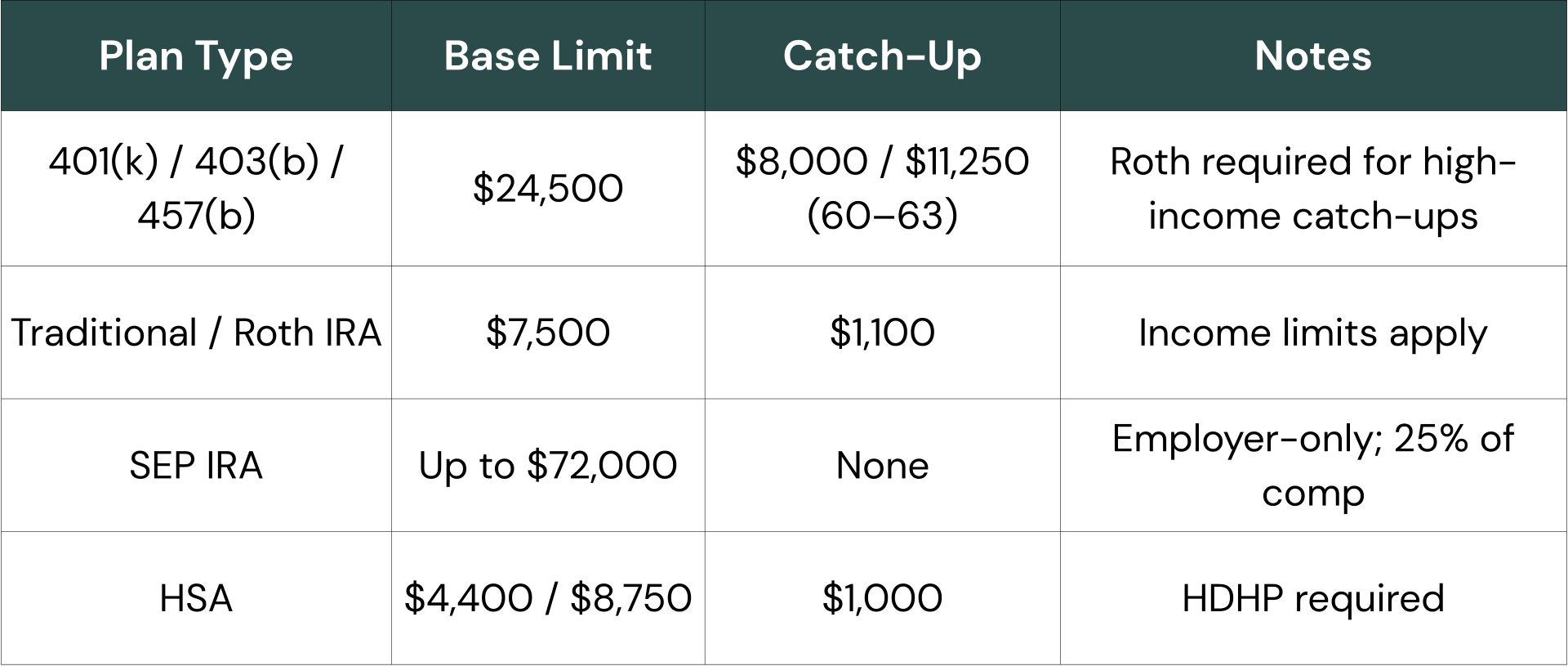
Source: Internal Revenue Service, Notice 2025-67, www.irs.gov/pub/irs-drop/n-25-67.pdf; Revenue Procedure 2025-19, http://www.irs.gov/pub/irs-drop/rp-25-19.pdf.
- Inherited IRAs: If you recently inherited retirement assets, you will need to pay attention to the 10-year distribution requirement. These rules vary based on several factors and differ depending on the relationship of the recipient.
- Roth Conversions: If your 2026 income will be artificially lower than in future years, a partial or full Roth conversion may be worth considering. Converting pre-tax retirement assets during a lower-income year can reduce the tax cost of conversion and may help limit future required minimum distributions in retirement.
Taxes
As highlighted in our article titled “The One Big Beautiful Bill Act (OBBBA): A new era in tax policy”, there are several tax law changes that took effect in 2026. The changes highlighted below underscore the importance of tax bracket management and the timing of certain itemized deductions.
Starting in 2026, taxpayers in the top 37% bracket face new limits on itemized deductions. Itemized deductions are now capped at a 35% benefit, causing taxpayers in the 37% tax bracket to receive a reduced benefit on their total itemized deductions.
The OBBBA increased the SALT deduction cap to $40,000, but there is an income-based phaseout, causing the benefit to erode rapidly for higher earners. The income phase-out range is $505,000 to $606,000 (Married Filing Jointly). Once a taxpayer exceeds the upper end of the phase-out range, their deduction reverts to the previous $10,000 SALT deduction cap.
Charitable Giving
Donating appreciated securities remains a highly efficient method for reducing tax liability, while also supporting charitable causes that align with your values. However, new limitations apply.
In addition to the new 35% cap on itemized deductions, taxpayers who itemize are now subject to a 0.5% adjusted gross income (AGI) floor for charitable contributions. This means charitable gifts must exceed the 0.5% threshold in order to generate a tax benefit. As a result, bunching multiple years of charitable contributions into a single calendar year may be worth considering.
Education planning
With education costs continuing to rise, contributing to a 529 plan is a great way to set aside funds for future education needs. While contributions are treated as a gift for gift tax purposes, a 529 plan allows for tax-free growth, investment flexibility, and beneficiary changes. Withdrawals used for qualified education expenses are tax free.
Alternatively, paying tuition directly to the institution is also a viable strategy. It’s often best used to fund near-term tuition costs and is not treated as a taxable gift.
Charting the Course for 2026
By staying proactive and informed, you’ll be well-positioned to make the most of your finances in 2026. Consult with your Simon Quick financial advisor, tax professional, or estate attorney to tailor these strategies to your specific circumstances and to navigate complex financial landscapes more effectively.
For more information on how Simon Quick can support your planning, reach out to us by email or phone: [email protected] | 973-525-1000.


