
Let’s Meet, on Your Terms
No pressure, no obligations — just an open conversation about your goals.


The key responsibilities of the Federal Reserve are simple and significant: maximize domestic employment while keeping inflation in check, all the while maintaining a well-functioning banking and financial markets system. While straightforward, this is a difficult task as unemployment and inflation often move in opposite directions and over-correcting one can undermine progress on the other. Further increasing the difficulty is that while the Fed can control interest rates and access to capital, the Treasury is responsible for fiscal spending and managing national debt. While the two institutions operate independently, they are intended to coordinate in order to support the long-term economic prosperity of the country.
However, there has been significant pressure from administration officials to influence monetary policy, reflecting a desire for lower borrowing costs to support the administration’s broader economic agenda. In January, Chair Powell announced that the Department of Justice had served the Federal Reserve with grand-jury subpoenas related to testimony concerning renovations to several Federal Reserve office buildings. Powell subsequently released a statement suggesting that the legal proceedings represent an attempt to influence monetary policy decisions at the Fed.
This development follows a separate effort to remove Federal Reserve Governor Lisa Cook from her position after administration officials accused her of mortgage fraud. While lower interest rates would likely support economic growth, preemptively cutting rates could risk reigniting inflation that is already at elevated levels. These actions also raise important questions about the Federal Reserve’s independence from political influence, which is widely viewed as essential to its ability to effectively carry out its mission.
The broader market implications of these developments may ultimately run counter to the administration’s objectives as a perceived erosion of Fed independence could lead to a loss of investor confidence in the central bank’s commitment to controlling inflation, potentially putting upward pressure on longer term interest rates.
Fed Review
The end of an era will soon be upon us. As it stands today, Jerome Powell’s 8-year tenure as the chair of the Federal Reserve is likely to come to an end in May 2026 and President Trump’s nominee, Kevin Warsh, will likely assume the Chairmanship, barring any delays – we note that Senator Tillis has indicated he would oppose the nomination “until the DOJ’s inquiry into Chairman Powell is fully and transparently resolved,” adding that “protecting the independence of the Federal Reserve from political interference or legal intimidation is non-negotiable.”
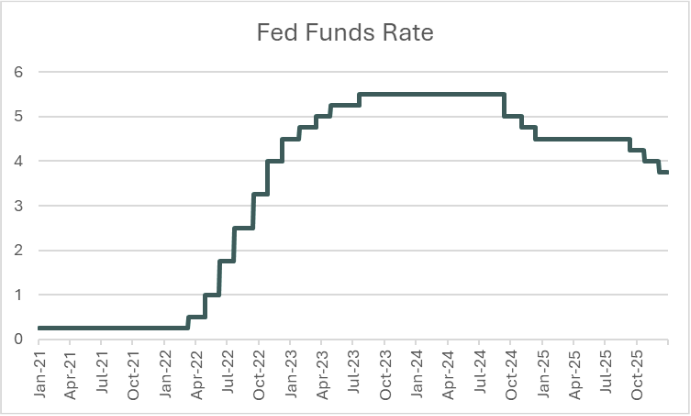
Under Powell, the FOMC delivered three consecutive 0.25% cuts in 2025, bringing the target range to 3.50% – 3.75%, a 1.75% reduction since September 2024. Powell believes the current target rate is now closer to neutral, which is typically defined as the level of interest rates that neither stimulates nor slows the economy.
Source: Bloomberg
The FOMC kept interest rates unchanged at its most recent meeting in January 2026, citing improved economic growth prospects and “some signs of stabilization in the labor market.” The market interpretation of the policy statement and subsequent press conference is that the Fed will hold interest rates steady for the next few meetings before conducting one or possibly two cuts under the leadership of the new fed chair. Warsh, who previously served as a Federal Reserve Governor from 2006 to 2011, has been a vocal critic of the Central Bank in recent years and his recent comments appear to align with the administration’s preference for even lower interest rates at this point.
2025 Review
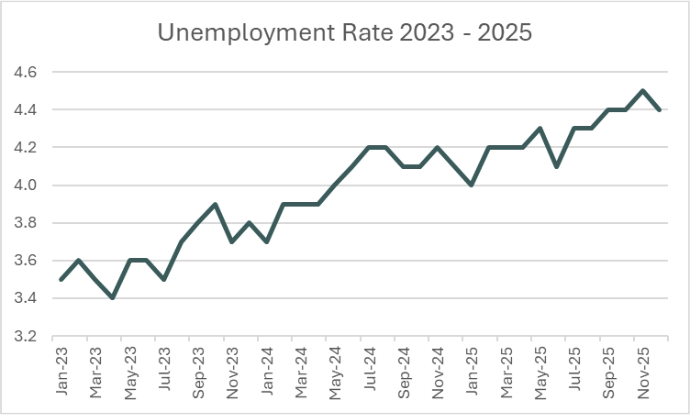
We believe the driving factor behind the Fed’s interest rate reduction path was the continued softening of the labor market last year as the U.S. unemployment rate rose from 4.1% to 4.4% as of year-end 2025.
Source: U.S. Bureau of Labor Statistics via FRED®
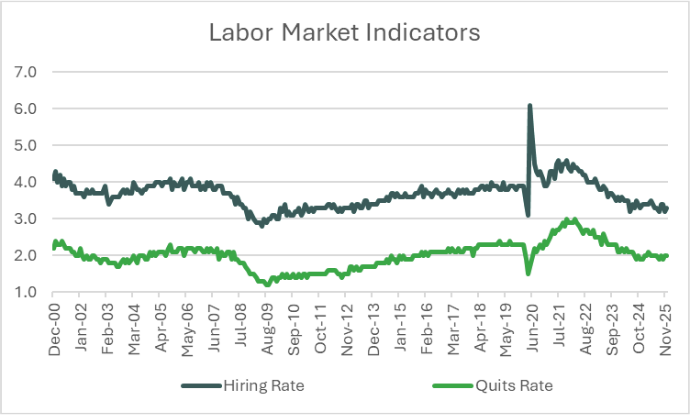
Payroll growth had also stalled, averaging just 49,000 jobs per month through December 2025. By comparison, job growth had averaged 216,000 and 168,000 new jobs per month in 2023 and 2024, respectively. Despite slowing job growth, the rise in the unemployment rate has been limited, driven by the belief that a reduction in immigration has slowed the growth of the labor force. In addition, the labor market has experienced a period of “balance,” characterized by a low-hire, low-fire environment. In this situation, fewer new jobs are created, while employers are reluctant to lay off existing workers, which helps keep unemployment lower.
Source: U.S. Bureau of Labor Statistics via FRED®
Trade and fiscal policy have added to the challenges for the Fed. The implementation of sweeping global tariffs initially threatened to derail the Fed’s progress toward returning inflation back to its two percent target while simultaneously dampening growth expectations. However, thus far this scenario has not materialized; and the current assessment is that tariffs will cause a one-time increase in inflation before gradually phasing out during 2026. The U.S. government shutdown this past fall lasted 43 days, the longest in history, resulting in the delay or outright cancellation of critical economic data. This uncertainty led Federal Reserve Chair Powell to use the analogy of “driving in the fog” to explain the possibility of moving more cautiously when it comes to adjusting interest rates.
The U.S. economy has remained resilient despite these headwinds. A key component of this relative strength has been the well-publicized boom in spending by companies involved in building AI infrastructure and other related sectors. Growth, to some extent, became reliant on this capital investment. According to the Federal Reserve Bank of St. Louis, AI-related investment categories contributed approximately 0.97% to real GDP growth during the first three quarters 2025 which is roughly 39% of total GDP growth over this period.
Similarly, consumer spending in 2025 also benefited from equity investments in AI-related stocks. The wealth effect from rising stock prices is estimated to have increased spending by 0.9%, according to JPMorgan. In effect, AI investments acted as a stabilizing growth engine, offsetting softer consumer demand, preventing overall growth from stalling, and supporting consumer spending at the margin.
The One Big Beautiful Bill Act (OBBA), which was signed into law on July 4, 2025, should further support the broader economy into 2026 through lower income taxes and higher disposable income for consumers.
The bill also delivers a supportive backdrop for corporate fundamentals in the near term by reviving several business-friendly provisions from the 2017 Tax Cuts and Jobs Act, including R&D expensing, bonus depreciation, and enhanced interest deductibility. The legislation strengthens cash flow, lowers effective corporate tax burdens, improves profitability, and encourages investment. Research suggests these restored provisions should help boost corporate profits in early 2026, offsetting some of the cost pressures created by tariffs and a tight labor market.
At the same time, the bill’s substantial fiscal expansion is projected to add trillions to the federal deficit over the next decade, potentially putting upward pressure on Treasury yields while also providing a near-term boost to disposable income and consumption, which could also push inflation slightly higher, moving it further away from the Fed’s 2% target and potentially slowing the pace of future cuts.
Investment Implications/Positioning
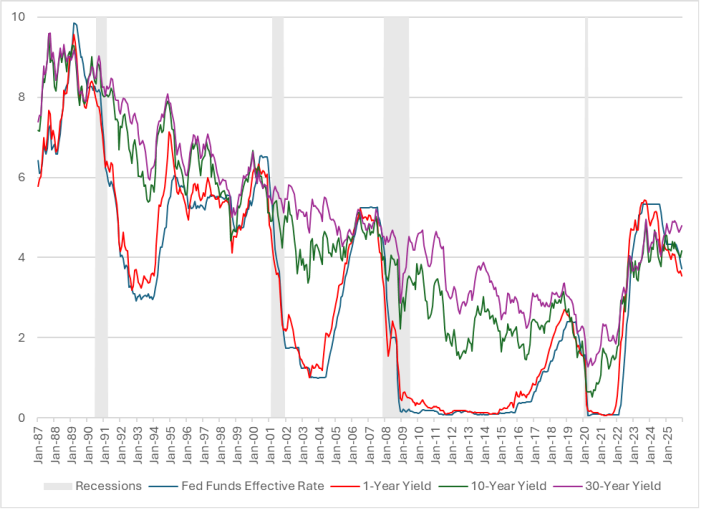
Ultimately, what matters most for clients is how these policy decisions will impact markets and investment portfolios. The decline in interest rates during 2025 was broadly supportive of equity markets. Lower rates have also benefited fixed income, particularly shorter-maturity bonds, which tend to be more sensitive to changes in Federal Reserve policy. For the year, the 2-year yield declined 77bps, the 10-year yield declined 40bps, while the 30-year yield rose 6bps, respectively. Longer-maturity bonds can be less impacted by near-term Fed actions and more by market expectations for inflation and fiscal policy.
Source: U.S. Bureau of Labor Statistics via FRED®, Bloomberg
Lower interest rates typically support the real estate market by stimulating demand through reduced mortgage costs. However, this effect has been muted, as mortgage rates tend to track longer-term yields, such as the 10-year Treasury. In addition, a persistent shortage of new housing supply and the large number of homeowners who locked in low mortgage rates during the pandemic have continued to weigh on transaction activity. To combat the supply issue, the White House has proposed several initiatives to lower mortgage rates including directing Fannie Mae and Freddie Mac to purchase $200 billion in mortgage-backed securities (MBS). This action caused mortgage rates to decline slightly after the announcement.
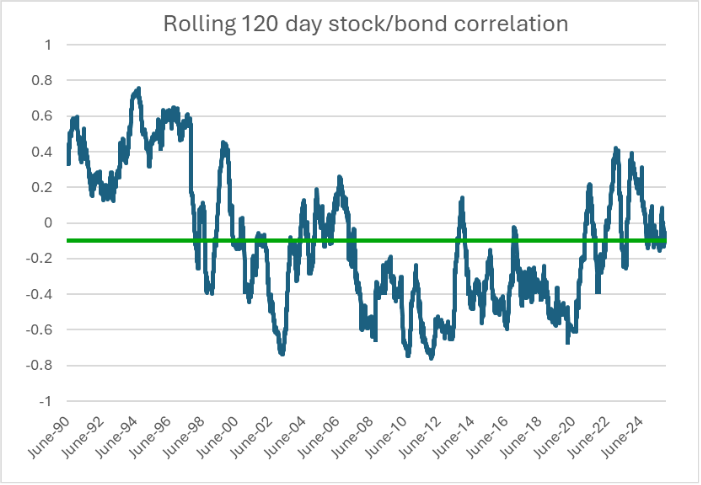
Markets were volatile in 2025. Fixed income was not spared, but ultimately generated attractive risk-adjusted returns for the year. Historically, bond and equity returns have been negatively correlated so that when stocks fell, bond prices tended to rise, providing diversification benefits. This relationship changed in the post-pandemic period as higher and more volatile inflation and aggressive interest rate hikes caused stock and bond prices to move more closely together. This has somewhat weakened bonds’ traditional role as a hedge for equities. It is important to understand this relationship is dynamic and can change as markets adjust to evolving macroeconomic conditions.
Source: SQ Investments. Bloomberg
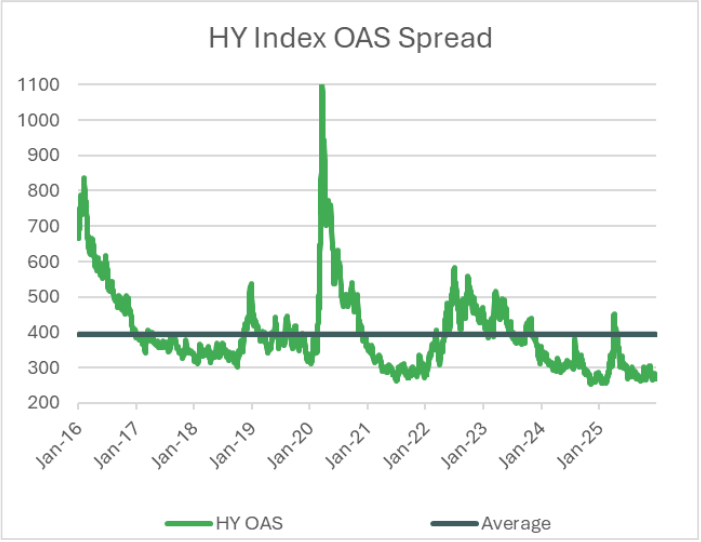
Public credit markets have been relatively stable over the past few years, driven by increased demand given the elevated yield and a benign default environment. This has resulted in credit spreads trading tight relative to historical averages.
Source: Bloomberg
Tight credit spreads typically mean investors are receiving less compensation for taking credit risk relative to the risk-free benchmark, usually Treasury securities. Further, the uneven and uncertain economic backdrop creates a situation where the risk/reward framework lends itself to more conservative positioning—meaning the probability of spreads moving tighter is lower than the probability of them going wider from a valuation perspective. As a result, we feel it is prudent to take a diversifying and move up-in-quality stance when taking credit risk to ensure portfolios are somewhat insulated from losses if spreads move wider due to either an economic slowdown or valuation concerns.
We continue to be cautious on duration (interest rate risk) as we kick off the new year. While we expect at least one more rate cut this year, the impact on longer-dated bonds may be more muted. Additionally, if fiscal spending were to cause inflation pressure to return, longer-dated bond yields could rise.
The key issue investors are facing today focuses on how the economy unfolds given the uncertain economic outlook. The Fed cut rates three times in 2025 and considers its current interest rate policy at the higher end of neutral. The possibility of stronger economic growth and continued elevated inflation as the economy accelerates from provisions in the OBBA could cause the Fed to slow its easing cycle, pushing yields higher. Additionally, if investors become increasingly concerned about the long-term stability of the fiscal deficit and debt levels, this could cause the price of longer-maturity bonds to decline as the term premium increases.
The primary risk to our shorter-duration posture is the labor market. The employment picture has softened as job growth has slowed and the unemployment rate has increased. If the Fed needs to cut rates aggressively due to labor-market stress causing the economy to deteriorate, duration will likely outperform, as long-term yields typically fall sharply in this scenario.
For private credit related income-oriented strategies, lower interest rates are expected to reduce distributions. We anticipate these strategies will generate high-single-digit returns for investors going forward. Despite more modest return expectations, we believe this segment continues to offer attractive risk-adjusted returns, particularly relative to public market alternatives.
As we progress through the course of the new year, market dynamics will continue to evolve alongside shifting economic conditions, monetary policy expectations, and fiscal considerations. In this environment, maintaining flexibility and discipline will be critical. While uncertainty remains elevated, periods of transition also create opportunities for thoughtful positioning and active risk management. We remain focused on navigating these changes with clients’ long-term objectives in mind, emphasizing diversification, quality, and resilience as markets adjust to the next phase of the cycle.
Important Disclosures
This information is for general and educational purposes only. You should not assume that any discussion or information contained herein serves as the receipt of, or as a substitute for, personalized investment advice from Simon Quick Advisors & Co., LLC (“Simon Quick”) nor should this be construed as an offer to sell or the solicitation of an offer to purchase an interest in a security or separate accounts of any type. Asset Allocation and diversifying asset classes may be used in an effort to manage risk and enhance returns. It does not, however, guarantee a profit or protect against loss. Investing in Liquid and Illiquid Alternative Investments may not be suitable for all investors and involves a high degree of risk. Many Alternative Investments are highly illiquid, meaning that you may not be able to sell your investment when you wish. Risk of Alternative Investments can vary based on the underlying strategies used.
Please remember that past performance may not be indicative of future results. Different types of investments involve varying degrees of risk, and there can be no assurance that the future performance of any specific investment, investment strategy, or product (including the investments and/or investment strategies recommended or undertaken by Simon Quick), or any non-investment related content, made reference to directly or indirectly in this newsletter will be profitable, equal any corresponding indicated historical performance level(s), be suitable for your portfolio or individual situation, or prove successful. Due to various factors, including changing market conditions and/or applicable laws, the content may no longer be reflective of current opinions or positions. To the extent that a reader has any questions regarding the applicability of any specific issue discussed above to his/her individual situation, he/she is encouraged to consult with the professional advisor of his/her choosing. Simon Quick is neither a law firm nor a certified public accounting firm and no portion of the newsletter content should be construed as legal or accounting advice. If you are a Simon Quick client, please remember to contact Simon Quick, in writing, if there are any changes in your personal/financial situation or investment objectives for the purpose of reviewing/evaluating/revising our previous recommendations and/or services.
Simon Quick Advisors, LLC (Simon Quick) is an SEC registered investment adviser with a principal place of business in Morristown, NJ. Simon Quick may only transact business in states in which it is registered, or qualifies for an exemption or exclusion from registration requirements. A copy of our written disclosure brochure discussing our advisory services and fees is available upon request. References to Simon Quick Advisors as being “registered” does not imply a certain level of education or expertise.
This newsletter and the accompanying discussion include forward-looking statements. All statements that are not historical facts are forward-looking statements, including any statements that relate to future market conditions, results, operations, strategies or other future conditions or developments and any statements regarding objectives, opportunities, positioning or prospects. Forward-looking statements are necessarily based upon speculation, expectations, estimates and assumptions that are inherently unreliable and subject to significant business, economic and competitive uncertainties and contingencies. Forward-looking statements are not a promise or guaranty about future events.
Economic, index, and performance information herein has been obtained from various third party sources. While we believe the source to be accurate and reliable, Simon Quick has not independently verified the accuracy of information. In addition, Simon Quick makes no representations or warranties with respect to the accuracy, reliability, or utility of information obtained from third parties.
Historical performance results for investment indices and/or categories have been provided for general comparison purposes only, and generally do not reflect the deduction of transaction and/or custodial charges, the deduction of an investment management fee, nor the impact of taxes, the incurrence of which would have the effect of decreasing historical performance results. It should not be assumed that your account holdings correspond directly to any comparative indices or benchmark index, as comparative indices or benchmark index may be more or less volatile than your account holdings. You cannot invest directly in an index.
Indices included in this report are for purposes of comparing your returns to the returns on a broad-based index of securities most comparable to the types of securities held in your account(s). Although your account(s) invest in securities that are generally similar in type to the related indices, the particular issuers, industry segments, geographic regions, and weighting of investments in your account do not necessarily track the index. The indices assume reinvestment of dividends and do not reflect deduction of any fees or expenses.
Please note: Indices are frequently updated and the returns on any given day may differ from those presented in this document. Index data and other information contained herein is supplied from various sources and is believed to be accurate but Simon Quick has not independently verified the accuracy of this information.