


Let’s Meet, on Your Terms
No pressure, no obligations — just an open conversation about your goals.


If you or your family owns a New York City residence that isn’t your primary home, whether it’s a co-op used a few weekends each month, a condo held in a trust for estate planning purposes, or a second home you’re not yet ready to sell, a new annual surcharge may appear on your January 1, 2027, property tax bill.
In July 2026, the New York City Department of Finance (DOF) finalized the rules for the Pied-à-Terre Tax and has already begun issuing notices to affected property owners. For many families, particularly those who own property through a trust or LLC, the deadline to respond may be approaching more quickly than expected, and the exemption rules are more complex than they initially appear.
Here’s what has changed, who may be affected, and the steps you should consider taking next. With both the litigation and the Department of Finance’s implementation guidance continuing to evolve, property owners should review the latest guidance before taking any action or submitting an exemption application.
Court Challenge Creates Uncertainty Around the Tax’s Implementation
On August 10, 2026, a New York Supreme Court judge issued a temporary restraining order in O’Brien v. City of New York, temporarily halting enforcement of the Pied-à-Terre Tax and directing the City to remove the publicly posted property roll while the case proceeds. The order also suspended further enforcement related to notices already issued to approximately 17,000 property owners. A hearing is scheduled for August 31, 2026.
The City filed an appeal shortly after the ruling and has stated that it intends to continue implementation, arguing that the appeal automatically stays the court’s order. As a result, the status of the September 18, 2026, exemption deadline remains uncertain.
Given the ongoing litigation, affected property owners should continue preparing for the September 18 exemption deadline and avoid delaying documentation or planning efforts. Waiting for the litigation to be resolved could create unnecessary time constraints if the tax ultimately proceeds as scheduled.
What Is the Pied-à-Terre Tax?
The Pied-à-Terre Tax is an annual surcharge imposed on certain New York City residential properties that are not used as a primary residence by an eligible occupant. The tax currently applies to:
- One-, two-, and three-family homes with a DOF-determined market value of $5 million or more; and
- Co-ops and condominiums with a DOF-determined market value of $1 million or more, which the DOF considers roughly equivalent to a $5 million single-family home under the current valuation methodology.
Beginning July 1, 2028, the tax is expected to transition to a new DOF market-value system under the enacted phase-in schedule, while maintaining the $5 million threshold.
In general, the tax does not apply if the property serves as the primary residence of the owner, a tenant, an immediate family member of the owner, or individuals who collectively hold a majority ownership interest in the entity that owns the property.
The surcharge applies to New York City fiscal years beginning on or after July 1, 2026, and is currently scheduled to expire on June 30, 2031, unless extended. Property owners subject to the tax should expect to see the first assessment reflected on the property tax bill due January 1, 2027.
How Much Is the Surcharge?
The applicable rate is determined by the property’s value bracket and applies to its entire DOF-determined value, not just the amount above the applicable threshold. Rates are also being phased in over two periods to reflect how DOF currently assesses condominiums and co-ops:
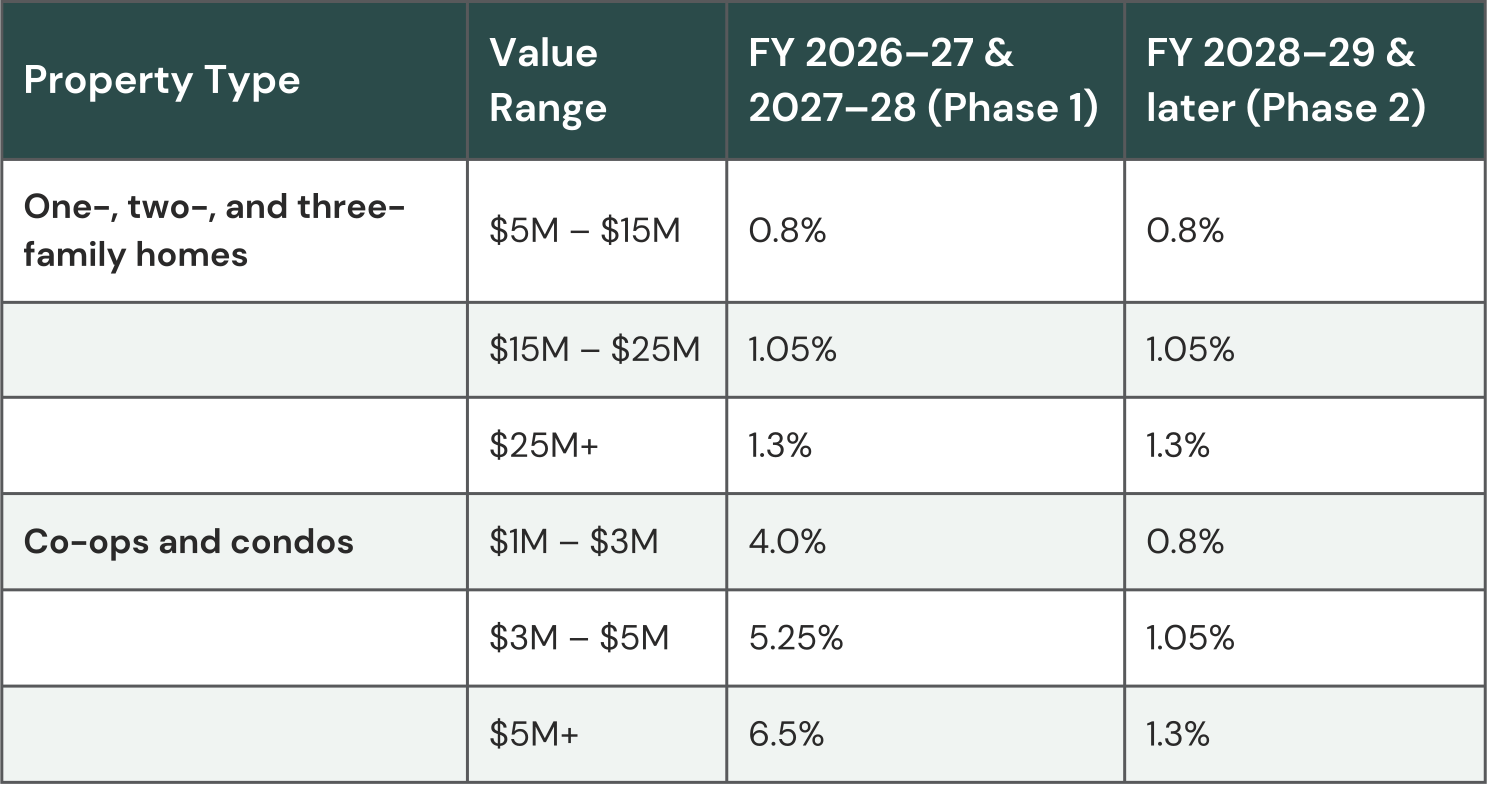
Source: NYC Department of Finance, “Non-primary residence surcharge” (Phase 1 rates for FY 2026–27 and FY 2027–28); Phase 2 figures reflect the enacted phase-in schedule under NYC Administrative Code §§ 11-3202–11-3204.
The higher Phase 1 rates for co-ops and condos reflect the DOF’s current valuation methodology, which uses an income-based approach that often results in values well below comparable market values. This methodology will remain in place until the valuation rules change in 2028.
For perspective: a home with a DOF market value just above $5 million, or a condo just above $1 million, would owe roughly $40,000 a year in Pied-à-Terre Tax on that DOF value (assuming no exemption), on top of existing property taxes. Higher-value properties can reach well into six figures.
The Clock Is Already Running
On July 22, 2026, the New York City Department of Finance (DOF) began mailing notices to owners whose properties did not yet have a documented primary residence on file with the city. The notices included a personalized PIN and instructions for filing an exemption claim.
On August 1, 2026, the DOF extended the filing deadline to September 18, 2026, for all property owners who received a notice. If you or your trust received one of these letters, the extension provides additional time to determine whether an exemption applies and submit the required documentation. Exemption claims must be filed electronically through the DOF’s online portal.
A property owner who receives a DOF notice should use the personalized PIN to submit an exemption application by the applicable deadline. The DOF will then review the submission and issue a determination on whether the surcharge applies. If the exemption is denied, the owner may challenge that determination through the Tax Commission’s appeal process.
The DOF also released a broader “Supplemental Market Value Roll” identifying properties that could potentially be subject to the tax. Appearing on that list alone did not trigger the September 18 exemption deadline, which applies only to owners who received an official mailed notice, though owners should still review the roll for valuation or ownership errors.
It’s also important to note that the DOF has until August 30, 2026, to issue notices for the current fiscal year. Accordingly, not receiving a notice does not necessarily mean a property is exempt. If your family owns a high-value New York City residence that is not used as a primary residence, it may be prudent to review the property’s assessment records rather than assume the tax does not apply simply because no notice was received.
Who Qualifies for an Exemption
An exemption may be available if the property serves as the primary residence of:
- The owner;
- A tenant or subtenant;
- Individuals who collectively hold a majority interest in the LLC, corporation, or partnership that owns the property;
- An immediate family member of the owner or majority-interest holder, including a spouse, child, sibling, parent, grandparent, or grandchild; or
- The sole beneficiary or beneficiaries of a trust that owns the property. Contingent or future beneficiaries generally are not considered for this purpose.
The DOF will consider several types of documentation when determining whether a property qualifies for the exemption. Applicants are generally asked to provide a recent state or federal income tax return or a driver’s license or other DMV-issued identification showing the property as the occupant’s permanent address. If neither is available, the DOF may accept a voter registration card along with other documentation establishing primary residency. Beginning with fiscal years starting on or after July 1, 2027, the DOF’s adopted rule also allows the agency to consider whether the owner occupied the property for a majority of days during the previous calendar year. However, this occupancy test does not apply to the current 2026-27 fiscal year, which relies primarily on the documentation requirements outlined above.
There is also an important rental exception to consider. A property leased to a tenant or subtenant under a bona fide, arm’s-length lease with a term of at least one year may still qualify as a primary residence, even if the owner does not occupy the property. However, the lease must reflect fair market rent and cannot be structured primarily to avoid the surcharge. The DOF generally requires supporting documentation, including either a copy of the current lease and one additional rental document, or a tenant or subtenant affidavit and two additional supporting documents.
Where It Gets Complicated: Trusts and Entities
This area warrants particular attention for families with more complex ownership structures, which account for a significant portion of New York City’s pied-à-terre owners. While the Department of Finance’s adopted rule has addressed several key issues, in some cases not in the taxpayer’s favor, other questions remain unresolved.
What the adopted rule has settled:
- Layered entity ownership is foreclosed, not just unclear: The DOF’s final rule makes clear that an individual cannot establish primary residency through a multi-tier business entity ownership structure. If a property is held through a chain of LLCs or partnerships, occupancy by an individual further up the ownership chain will not qualify for the exemption.
- Contingent and future trust beneficiaries are excluded by rule: The DOF’s adopted rule confirms that contingent or future interests in a trust are disregarded when determining whether an individual qualifies as a sole beneficiary, or one of several sole beneficiaries, for purposes of the exemption.
What remains genuinely unsettled:
- Revocable grantor trusts: It remains unclear whether a residence held in a revocable grantor trust qualifies for the exemption when the individual occupying the property is the grantor rather than a named beneficiary. The adopted rule defines qualifying trust occupants based on beneficiary status but does not separately address occupancy by a grantor.
- Trusts with multiple current beneficiaries: The DOF’s rule confirms that multiple current beneficiaries may collectively qualify as the trust’s sole beneficiary class, with contingent or future interests disregarded. What remains open is how the DOF will document and administer the exemption when only some of the current beneficiaries occupy the property.
- “Primary resident trustee”: Published commentary indicates that the DOF’s mailed notices reference an exemption for a “primary resident trustee.” That phrase does not appear in the DOF’s codified rule, which instead identifies a trustee as someone authorized to act on an owner’s behalf as a “duly authorized representative.” This is distinct from establishing residency. The rule does not address whether or how a trustee’s own occupancy affects eligibility for the exemption, so the actual notice language should be reviewed before relying on this treatment.
If your family’s New York City property is held in a trust or entity, these distinctions matter. Some ownership structures now have a definitive, if unfavorable, answer, while others still require case-by-case analysis before filing.
What to Do Now
Despite the pending litigation, there are several steps property owners should consider taking now rather than waiting for the August 31 hearing:
- Continue preparing despite the litigation. Confirm directly through the DOF property assessment roll whether your property may be subject to the tax. Do not rely solely on a mailed notice, particularly if notices are delayed or paused. Continue preparing for the September 18 exemption deadline in case the restraining order is lifted.
- Build a complete and consistent documentation file. Gather tax returns, occupancy records, trust agreements, entity governing documents, or lease agreements that support primary-residence or qualifying rental status. Make sure the information is consistent with your New York State income tax filings and other domicile records.
- Coordinate with your estate planning attorney and tax advisor. If the property is held in a trust, LLC, partnership, or other entity, get advice before filing. Some ownership questions now have clear, if unfavorable, answers under the DOF’s adopted rule, while others remain genuinely open. A coordinated review will tell you which situation you’re in.
- If no exemption applies, plan for the surcharge as an ongoing cost of ownership. The Pied-à-Terre Tax is an annual surcharge, not a one-time fee, so it should be incorporated into the property’s long-term ownership and cash-flow planning.
The Bottom Line
The Pied-à-Terre Tax adds a new, and in some cases substantial, cost to owning a non-primary residence in New York City. At the same time, several questions remain about how the rules apply to common trust and entity ownership structures. The pending litigation adds another layer of uncertainty, but it should not be a reason to delay planning.
If you have received a DOF notice or your estate plan includes New York City property held in a trust or entity, now is the time to review the ownership structure, occupancy arrangements, and potential exemption opportunities. Taking action now can help ensure you’re prepared before the exemption filing window closes, should the current requirements ultimately take effect.
At Simon Quick Advisors, real estate and trust structures are an important part of the planning conversations we have with clients. If you would like a second set of eyes on your exemption filing or want to understand how the Pied-à-Terre Tax fits into your broader wealth and estate plan, let’s talk.
Sources
Primary authority
NYC Department of Finance, Notice of Adoption of Final Rules, “Surcharge on Property That Does Not Serve as a Primary Residence,” 19 RCNY ch. 62, adopted July 10, 2026, including the accompanying Statement of Basis and Purpose (cited by section throughout as “19 RCNY § 62-__”).
New York City Administrative Code, title 11, chapter 32 (§§ 11-3201 to 11-3207), the enabling statute for the surcharge (Part HH of Chapter 59 of the Laws of 2026).
NYC Department of Finance, “Non-primary residence surcharge,” nyc.gov (program overview, current exemption deadlines, and application process).
Disclaimer
This material is provided for informational and educational purposes only and is not intended as, and should not be construed as, legal, tax, or accounting advice. The information contained herein is based on sources believed to be reliable; however, Simon Quick Advisors, LLC (“Simon Quick”) makes no representations or warranties as to its accuracy, completeness, or suitability for any particular purpose, and the information may change without notice.
Simon Quick is a registered investment adviser but is not a law firm or an accounting firm. Simon Quick does not provide legal or tax advice, does not interpret state residency statutes or regulations, and does not represent clients in residency audits, tax disputes, or other legal proceedings. State residency rules are complex, fact-specific, and subject to varying interpretations by taxing authorities.
Clients should consult with qualified legal counsel, state and local tax professionals, or certified public accountants regarding their specific circumstances, including the steps necessary to establish domicile, reduce potential exposure to state taxation, and prepare any required filings. Any actions taken or decisions made based on this material are the sole responsibility of the recipient.
Simon Quick may only transact business, or render personalized investment advice, in those states and jurisdictions where it is properly registered or otherwise exempt from registration. This communication does not constitute an offer to provide advisory services in any jurisdiction where Simon Quick is not registered or exempt.
Simon Quick Advisors, LLC (“Simon Quick”), together with its affiliates, officers, employees, and related persons, may have financial or other interests that could conflict with the interests of clients, including compensation arrangements, referral relationships, or interests in the products or strategies discussed herein. Simon Quick addresses these conflicts through its policies and procedures. Clients and prospective clients are encouraged to review Simon Quick’s Form ADV Part 2A for a complete description of material conflicts of interest, available upon request or through the SEC’s Investment Adviser Public Disclosure website.
Receipt or review of this document does not create an advisory, legal, tax, or fiduciary relationship beyond the scope of your existing engagement with Simon Quick.

