
Let’s Meet, on Your Terms
No pressure, no obligations — just an open conversation about your goals.


By: Anthony Santoro Esq. and Kyle Cunningham, EA
I. Executive Summary
The One Big Beautiful Bill Act (“OBBBA”), signed into law on July 4, 2025, significantly expanded the qualified small business stock (QSBS) exclusion under Section 1202 of the Internal Revenue Code. These changes represent the most meaningful overhaul of the QSBS regime since Congress extended the 100% exclusion in 2010.
This article summarizes our views on the key statutory changes, analyzes planning opportunities and traps, and provides examples of planning strategies to consider. All changes apply to QSBS issued after July 4, 2025; pre-OBBBA stock continues to be governed by prior law.
II. Statutory Context: Section 1202 Before the OBBBA
Section 1202, enacted as part of the Omnibus Budget Reconciliation Act of 1993, was designed to encourage investment in early-stage domestic C corporations by allowing noncorporate taxpayers to exclude capital gains on qualifying stock dispositions. The principal requirements under prior law were:
- The issuing entity must be a domestic C corporation with aggregate gross assets not exceeding $50 million at the time of issuance.
- The stock must be acquired at original issuance (not in a secondary transaction) for money, property, or services.
- The taxpayer must hold the stock for more than five years — an “all or nothing” threshold.
- The exclusion is capped at the greater of $10 million or 10 times the taxpayer’s adjusted basis in the stock per issuer.
- The corporation must be an active business in a qualifying trade or business (excluding hospitality, financial services, law, health, and certain other service industries) throughout substantially all of the taxpayer’s holding period.
For stock acquired after September 27, 2010, the exclusion was 100% of eligible gain, with no alternative minimum tax (AMT) preference. Prior-period stock enjoyed 50% or 75% exclusions depending on acquisition date.
III. Understanding Key Changes in the OBBBA
The OBBBA enacted three principal amendments to Section 1202, each applying exclusively to QSBS issued after July 4, 2025.
A. Graduated Holding Period with Tiered Exclusion
Under prior law, the five-year holding period was mandatory to access any exclusion. The OBBBA converts this binary requirement into a graduated schedule:
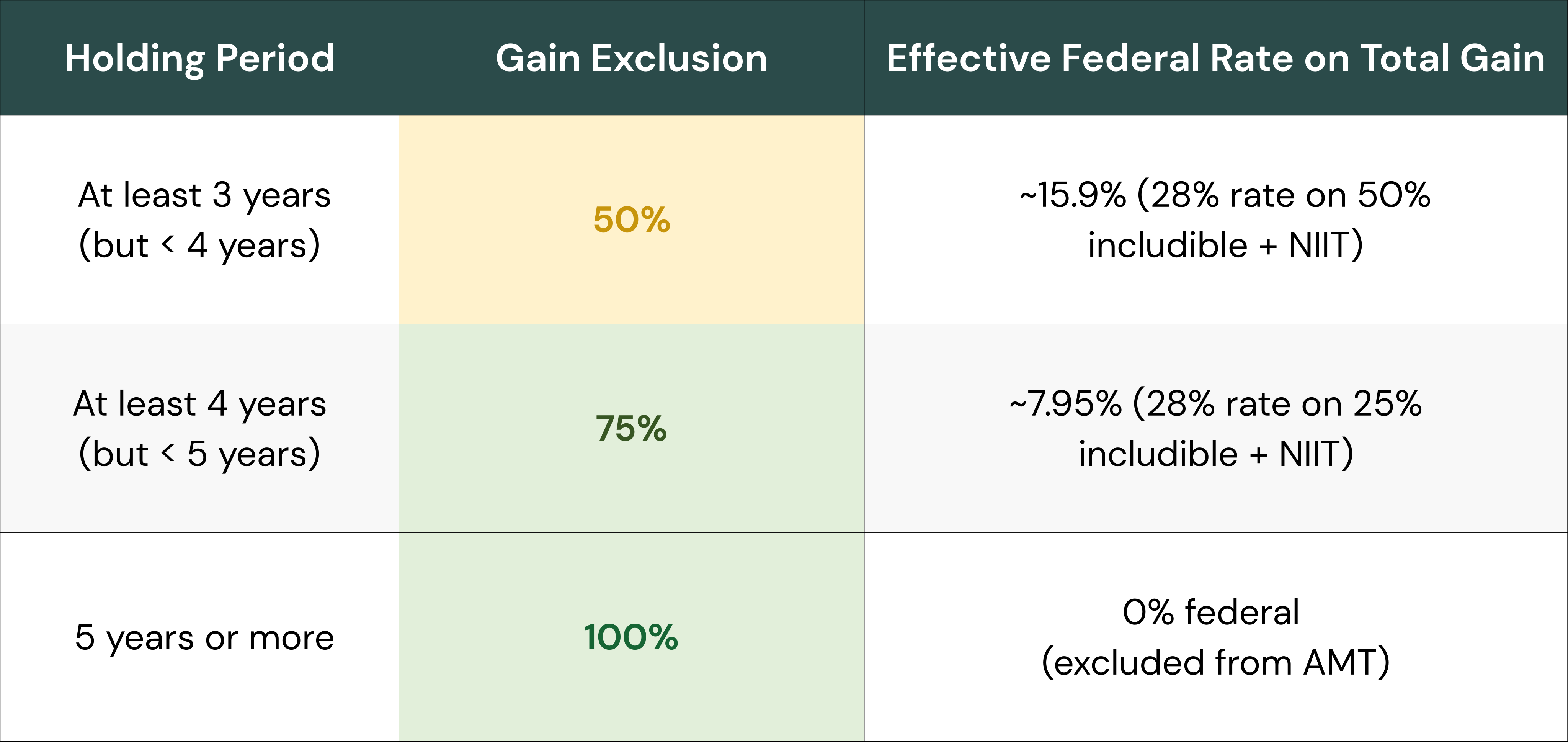
Note: The includible gain on partial dispositions (3- and 4-year holds) is taxed at the special 28% capital gains rate under Section 1202, not the standard 15%/20% long-term capital gains rate, plus 3.8% Net Investment Income Tax (NIIT) where applicable. Investors holding QSBS with a 3- or 4-year holding period should compare the effective rate against the standard capital gains rate applicable to non-QSBS stock before concluding that an early exit is beneficial.
B. Increased Per-Taxpayer, Per-Issuer Gain Exclusion Cap
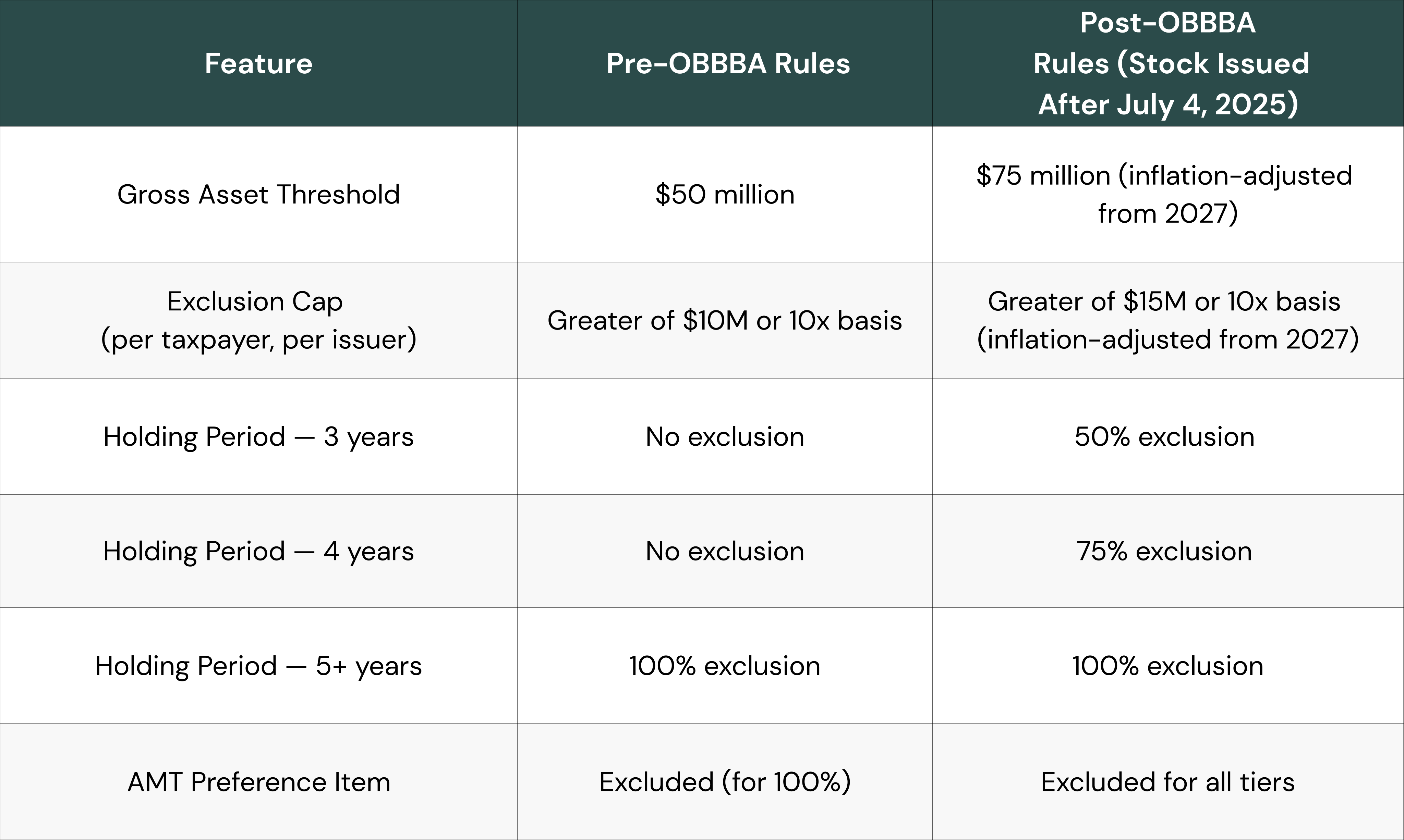
The maximum eligible gain that may be excluded per taxpayer, per issuing corporation is increased from $10 million to $15 million for QSBS issued after July 4, 2025. Beginning in 2027, this cap is subject to annual inflation adjustment. The 10x-basis alternative remains in place — the exclusion equals the greater of $15 million or 10 times the taxpayer’s adjusted basis.
Key planning point: The $10 million and $15 million caps are not additive. A taxpayer cannot stack pre-OBBBA and post-OBBBA QSBS from the same issuer to obtain a combined $25 million exclusion.
C. New Increased Aggregate Gross Asset Threshold Explained
The gross asset threshold that the issuing corporation must satisfy for its stock to qualify as QSBS is increased from $50 million to $75 million, applicable to stock issued after July 4, 2025. This threshold is also subject to inflation adjustment starting in 2027.
The pre-OBBBA $50 million threshold remains applicable to stock issued on or before July 4, 2025. Notably, a corporation that previously reached the $50 million threshold without issuing QSBS may begin issuing qualifying QSBS on July 5, 2025, until it reaches the new $75 million threshold — provided all other requirements are met.
IV. Old vs. New Rules — A Summary Comparison Guide
V. Practical Examples of Planning Strategies
Below, we will consider some hypothetical examples that demonstrate how certain planning strategies may work to your advantage.
The following examples assume all basic QSBS requirements are met (domestic C corporation, original issuance, active qualified business, etc.). Federal tax calculations use a 28% rate on includible QSBS gain and a 23.8% rate (20% + 3.8% NIIT) on non-QSBS long-term capital gain for comparison purposes.
Example 1: Founder with Low Basis (Pre- vs. Post-OBBBA)
Scenario: Maria, a founder, received 1,000,000 shares of Tech-Co (a domestic C corporation) in August 2025 at a basis of $0.50/share ($500,000 total). The company was valued at less than $75 million at issuance. In 2030 (5 years later), Tech-Co is acquired and Maria’s shares are valued at $20 million — a $19.5 million gain.
Analysis:
- The exclusion cap is the greater of $15 million or 10x basis ($5 million). Therefore, the cap is $15 million.
- Maria excludes $15 million of gain; the remaining $4.5 million is includible and taxed at 23.8%, yielding $1,071,000 of Federal tax.
- Without QSBS, Maria’s $19.5 million gain at 23.8% would produce $4,641,000 of Federal tax.
- Net QSBS benefit: approximately $3,570,000 in Federal tax savings.
Compared to pre-OBBBA: Under the old $10 million cap, Maria would have excluded $10 million, paid 23.8% on $9.5 million ($2,261,000), and saved only $2,380,000 in tax — $1.2 million less than under the OBBBA.
Example 2: Investor with High Basis (10x Applies)
Scenario: A venture capital fund (held through a pass-through to a noncorporate taxpayer) invested $2,000,000 in Series A stock of Bio-Startup in September 2025. Bio-Startup had $60 million in gross assets at issuance (qualifying under the new $75 million threshold). Five years later, the investment is sold for $25 million — a $23 million gain.
Analysis:
- The exclusion cap is the greater of $15 million or 10x basis ($20 million). Therefore, 10x basis applies — $20 million excluded.
- The remaining $3 million of gain is includible and taxed at 23.8% ($714,000 Federal tax).
- Without QSBS, the $23 million gain at 23.8% would yield $5,474,000.
- Net QSBS benefit: approximately $4,760,000 in Federal tax savings.
Note: Under pre-OBBBA rules, Bio-Startup would not have qualified (gross assets exceeded $50 million). The OBBBA’s $75 million threshold is what enables this planning opportunity.
Example 3: Evaluating Early Exit (3-Year Hold) vs. Holding Longer
Scenario: David, a founder, invested $1,000,000 in Clean-Energy Corp in October 2025. In October 2028 (3 years), he receives an acquisition offer yielding $8 million total ($7 million gain). He considers whether to sell now or wait another year.
Option A: Sell at 3 years (50% exclusion):
- Excluded gain: $3.5 million. Includible gain: $3.5 million taxed at 31.8% = $1,113,000 Federal tax.
Option B: Sell at 4 years (75% exclusion, assuming same $8M value):
- Excluded gain: $5.25 million. Includible gain: $1.75 million taxed at 31.8% = $556,500 Federal tax.
Conclusion: Waiting one additional year saves approximately $556,500 in Federal tax. If the investment is expected to appreciate during year 4, the case for waiting strengthens further. Clients should weigh investment risk, liquidity needs, and state tax consequences before deciding.
Example 4: SLANT Stacking: Spousal Lifetime Access Non-Grantor Trust
Background: A Spousal Lifetime Access Non-Grantor Trust (“SLANT”) is an irrevocable trust structured so that (i) it is not treated as a grantor trust for income tax purposes, meaning it files its own tax return as a separate taxpayer, and (ii) the grantor’s spouse is a permissible discretionary beneficiary, providing indirect family access to trust assets during the grantor’s lifetime. Because the SLANT is a separate non-grantor taxpayer, it can independently hold QSBS and claim its own Section 1202 exclusion cap, potentially stacking exclusions beyond what the founder and spouse could claim individually.
Scenario: James is a co-founder of Data-AI Corp, a domestic C corporation that issued QSBS after July 4, 2025. James’s total adjusted basis in his QSBS shares is $250,000. Before the company raises its next funding round (while its gross assets are still well below $75 million), James transfers a portion of his QSBS to two separate entities, each of which independently acquires the stock at original issuance or via a qualifying transfer:
- James holds shares personally (basis: $125,000).
- A SLANT (irrevocable non-grantor trust, sited in a non-income-tax state such as Nevada or South Dakota, with James’s spouse as a discretionary beneficiary) acquires shares at original issuance with a basis of $125,000, funded by James via a completed gift using his remaining lifetime exemption.
Seven years later, Data-AI Corp is acquired. The total enterprise value attributable to James’s combined shares is $50 million ($25 million to James personally, $25 million to the SLANT).
Analysis: Without the SLANT:
- James’s per-issuer cap: the greater of $15 million or 10x basis ($2,500,000).
- James excludes $15 million; the remaining $35 million of gain (less $250,000 basis) is taxed at 23.8% = $8,270,500 Federal tax.
Analysis: With the SLANT:
- James personally excludes $15 million of gain; the remaining $10 million of gain (less $125,000 basis) is taxed at 23.8% = $2,350,250 Federal tax.
- The SLANT, as an independent non-grantor taxpayer, has its own cap: the greater of $15 million or 10x its basis ($1,250,000). The SLANT excludes $15 million; the remaining $10 million (less $125,000 basis) is taxed at the trust’s applicable rate (23.8%) = $2,350,250.
- Combined Federal tax: $4,700,500. Net tax saving vs. no SLANT: approximately $3,570,000. Total excluded gain across both taxpayers: $30 million out of $50 million.
State tax benefit: Because the SLANT is a non-grantor trust sited in a non-income-tax state (e.g., Nevada), and neither James nor his spouse is treated as the trust’s taxpayer for income tax purposes, the trust’s QSBS gain, both excluded and partially includible, may avoid state income tax entirely, even if James is domiciled in a high-tax state such as California or New York.
VI. Key Planning Considerations and Cautions
A. State Tax Conformity
Not all states conform to the Federal QSBS exclusion. As of the OBBBA’s enactment, the following states do not conform, meaning excluded Federal gain remains fully taxable at the state level: Alabama, California, Mississippi, Pennsylvania, and (previously) New Jersey (which enacted conformity effective January 1, 2026). Hawaii and Massachusetts offer only partial conformity. Clients in high-tax non-conforming states (notably California, which imposes a ~13.3% top rate) will experience a substantially reduced net benefit. Always verify your state’s current treatment of QSBS in your analysis.
B. No Retroactive Conversion of Pre-OBBBA QSBS
The OBBBA changes apply only to stock issued after July 4, 2025. Exchanges of pre-OBBBA QSBS (e.g., in Section 351 transfers, tax-free reorganizations, or Section 1045 rollovers) will generally not convert old stock into new QSBS — holding-period carryover rules preserve the original acquisition date. Clients should not attempt to “refresh” pre-OBBBA stock.
C. Qualified Business Requirement
The active business requirement and excluded industry rules under Section 1202(e) remain unchanged. Businesses in financial services, professional services (law, accounting, consulting, health), hospitality, athletics, and similar fields do not qualify. This remains a threshold issue requiring early diligence.
D. Documentation and Recordkeeping
You should ensure the company establishes and maintains the following documentation contemporaneously:
- Gross asset certifications from the corporation at each issuance date.
- Original issuance confirmation and capitalization table records.
- Business activity analysis confirming qualifying trade or business status.
- Segregation of pre- and post-OBBBA stock by certificate or book-entry to facilitate sequential sale strategies.
E. Impact on Entity Structure Decisions
The OBBBA’s enhancements may influence entity form decisions. The possibility of partial exclusion after only 3 years — and the higher gross asset threshold — make C corporation status more attractive for growth-stage companies that were previously considering pass-through structures. Conversion to C corporation status should be analyzed carefully, including the impact on the gross asset test (contributions of appreciated property are tested at fair market value).
VII. Client Action Items to Consider
- Review existing QSBS holdings to determine whether stock is pre- or post-OBBBA and model potential exclusion amounts under both regimes.
- For clients with stock near the 3- or 4-year mark, analyze the cost-benefit of early exit versus waiting, accounting for investment appreciation risk and state tax exposure.
- For companies nearing the gross asset threshold, evaluate timing of new equity issuances to ensure stock is issued before the $75 million limit is exceeded.
- Assess entity structure for clients operating as partnerships or S corporations who may benefit from C corporation conversion.
- Establish segregated recordkeeping for pre- and post-OBBBA stock from the same issuer to preserve sequential sale opportunities.
- For high-net-worth founders, evaluate trust-based stacking strategies in conjunction with state residency and domicile planning.
- Monitor IRS guidance on OBBBA implementation, particularly regarding carryover holding period rules and rollover provisions.
DISCLAIMER
This information is for general and educational purposes only. You should not assume that any discussion or information contained herein serves as the receipt of, or as a substitute for, personalized investment advice from Simon Quick Advisors & Co., LLC (“Simon Quick”) nor should this be construed as an offer to sell or the solicitation of an offer to purchase an interest in a security or separate accounts of any type. Asset Allocation and diversifying asset classes may be used in an effort to manage risk and enhance returns. It does not, however, guarantee a profit or protect against loss. Investing in Liquid and Illiquid Alternative Investments may not be suitable for all investors and involves a high degree of risk. Many Alternative Investments are highly illiquid, meaning that you may not be able to sell your investment when you wish. Risk of Alternative Investments can vary based on the underlying strategies used.
Please remember that past performance may not be indicative of future results. Different types of investments involve varying degrees of risk, and there can be no assurance that the future performance of any specific investment, investment strategy, or product (including the investments and/or investment strategies recommended or undertaken by Simon Quick), or any non-investment related content, made reference to directly or indirectly in this newsletter will be profitable, equal any corresponding indicated historical performance level(s), be suitable for your portfolio or individual situation, or prove successful. Due to various factors, including changing market conditions and/or applicable laws, the content may no longer be reflective of current opinions or positions. To the extent that a reader has any questions regarding the applicability of any specific issue discussed above to his/her individual situation, he/she is encouraged to consult with the professional advisor of his/her choosing. Simon Quick is neither a law firm nor a certified public accounting firm and no portion of the newsletter content should be construed as legal or accounting advice. If you are a Simon Quick client, please remember to contact Simon Quick, in writing, if there are any changes in your personal/financial situation or investment objectives for the purpose of reviewing/evaluating/revising our previous recommendations and/or services.
Simon Quick Advisors, LLC (Simon Quick) is an SEC registered investment adviser with a principal place of business in Morristown, NJ. Simon Quick may only transact business in states in which it is registered, or qualifies for an exemption or exclusion from registration requirements. A copy of our written disclosure brochure discussing our advisory services and fees is available upon request. References to Simon Quick Advisors as being “registered” does not imply a certain level of education or expertise.
This newsletter and the accompanying discussion include forward-looking statements. All statements that are not historical facts are forward-looking statements, including any statements that relate to future market conditions, results, operations, strategies or other future conditions or developments and any statements regarding objectives, opportunities, positioning or prospects. Forward-looking statements are necessarily based upon speculation, expectations, estimates and assumptions that are inherently unreliable and subject to significant business, economic and competitive uncertainties and contingencies. Forward-looking statements are not a promise or guaranty about future events.
Economic, index, and performance information herein has been obtained from various third party sources. While we believe the source to be accurate and reliable, Simon Quick has not independently verified the accuracy of information. In addition, Simon Quick makes no representations or warranties with respect to the accuracy, reliability, or utility of information obtained from third parties.
Historical performance results for investment indices and/or categories have been provided for general comparison purposes only, and generally do not reflect the deduction of transaction and/or custodial charges, the deduction of an investment management fee, nor the impact of taxes, the incurrence of which would have the effect of decreasing historical performance results. It should not be assumed that your account holdings correspond directly to any comparative indices or benchmark index, as comparative indices or benchmark index may be more or less volatile than your account holdings. You cannot invest directly in an index.
Indices included in this report are for purposes of comparing your returns to the returns on a broad-based index of securities most comparable to the types of securities held in your account(s). Although your account(s) invest in securities that are generally similar in type to the related indices, the particular issuers, industry segments, geographic regions, and weighting of investments in your account do not necessarily track the index. The indices assume reinvestment of dividends and do not reflect deduction of any fees or expenses.
Please note: Indices are frequently updated and the returns on any given day may differ from those presented in this document. Index data and other information contained herein is supplied from various sources and is believed to be accurate but Simon Quick has not independently verified the accuracy of this information.
*Please Note: Limitations: The above is a hypothetical scenario-not involving an actual Simon Quick Advisors, LLC client. It illustrates the hypothetical experience of a fictitious client based on a scenario that an actual client might experience. The scenario is designed to help illustrate how Simon Quick might provide services to similarly situated clients. Keeping in mind that no two clients, situations, or experiences are exactly alike, the above should not be construed as an endorsement of Simon Quick by any of its past or current clients, nor any assurance that Simon Quick may be able to help any client achieve the same satisfactory results. To the contrary, there can be no assurance that a client or prospective client will experience a certain level of results or satisfaction if Simon Quick is engaged, or continues to be engaged, to provide investment advisory services. A copy of our current written disclosure Brochure discussing our advisory services and fees continues to remain available upon request or at www.simonquickadvisors.com.