
Let’s Meet, on Your Terms
No pressure, no obligations — just an open conversation about your goals.


What a year! Despite significant geopolitical developments and frequent headline risk, financial markets performed admirably in 2025. Equities delivered positive returns across geographies, sectors, styles, and market capitalizations, while global bond markets advanced, posting high single-digit returns. Commodities, particularly precious metals, closed out the year with strong performance as well.
This outcome, however, did not come without challenges. Investors were required to navigate multiple bouts of volatility and an unusually dense set of macro and geopolitical risks. These included tariffs rising to their highest levels in nearly a century, the longest U.S. government shutdown on record, renewed scrutiny around AI investment and Chinese competition (remember DeepSeek!?), and escalating conflict in the Middle East. This pace hasn’t slowed as we kicked off 2026 with a US-led overthrow of the Maduro administration in Venezuela. Patience, diversification, and a disciplined approach to risk ultimately proved to be the winning formula in 2025.
While expectations are for another strong year of returns in 2026, supported by continued global growth and productivity tailwinds from AI, risk remains. Valuations for U.S. equities sit near the upper end of historic ranges, geopolitical tensions involving the U.S., China, Russia, and now parts of South America remain elevated, labor markets are showing signs of softening, and investor tolerance for sustained AI capital expenditures without clear revenue realization may be waning. Given the inherent difficulties of forecasting how these dynamics will unfold, Simon Quick continues to emphasize the importance of diversified portfolios across asset classes and risk factors as the most effective way to navigate an uncertain environment.
Economic Update
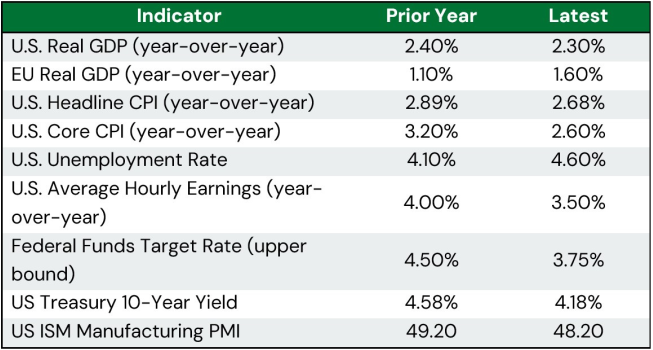
Prior Year as of 12/31/2024
Latest data as of: US Real GDP, EU Real GDP – Q3 2025; US Headline CPI, US Core CPI, US Unemployment Rate, US Average Hourly Earnings, Federal Funds Target Rate, US Treasury, & US ISM Manufacturing PMI – December 2025; US Treasury 10-Year Yield – 12/31/2025. Sources: U.S. Real GDP – Bureau of Economic Analysis; EU Real GDP – Eurostat; U.S. Headline CPI, U.S. Core CPI, U.S. Unemployment Rate, U.S. Average Hourly Earnings – Bureau of Labor Statistics; Federal Funds Target Rate, US Treasury 10-Year Yield – US Federal Reserve; US ISM Manufacturing PMI – Institute for Supply Management
Domestic GDP remained resilient in 2025, advancing 2.3% year-over-year through Q3, with expectations for another strong quarter in Q4. This is despite the negative quarter of growth experienced in Q1 which was impacted by tariff-front running, and a government shutdown that lasted over a month in Q4.
This resiliency was due in large part to US consumers doing what they do best – consume – as personal consumption expenditures increased across both goods and services, despite the smattering of headlines throughout the year that could have warranted more cautious behavior. In addition, the US saw a boost from the high levels of capital expenditures in relation to artificial intelligence and the buildout of datacenters designed to power AI models. The level of private investment in IT equipment and software, including information processing equipment, software, and communication equipment, reached just under 4.5% of GDP in Q3, an all-time high. This trend underscores a key driver of the strength seen across semiconductor companies like Nvidia in recent years.
Contributors to Real GDP Growth
Quarter-over quarter, seasonally adjusted annualized rate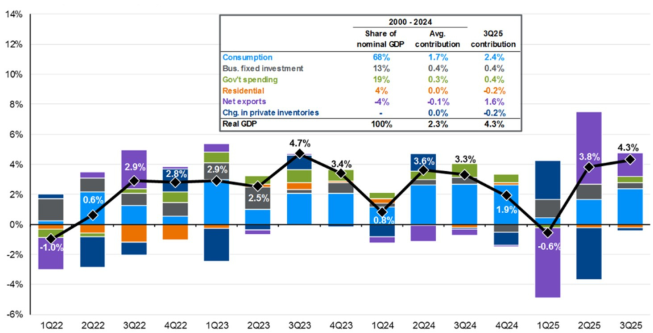 Source: JP Morgan
This strength would have come as a major surprise to many investors and economists in the first half of 2025, when escalating tariff threats from the Trump administration caused many to assume a breakdown in global trade and subsequent recession was a growing certainty. The market reaction to the tariffs proposed on “Liberation Day” proved too dramatic for the Trump administration to stomach, and the market rallied aggressively over Q2 as the effective tariff rate continued to fall. Interestingly, markets continued to rally even as tariff rhetoric grew tough again over the summer and the effective tariff rate clawed back higher. As of the end of the year, the effective tariff rate in the US is sitting above 15% based on currently enacted levies, about 7-times the rate from the beginning of the year.
Monthly Tariff Revenue and Effective Tariff Rate
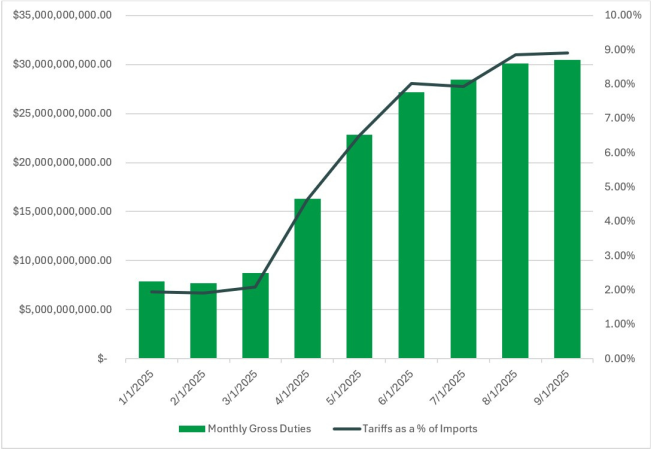 Source: US Census Bureau, Bureau of Economic Analysis, fiscaldata.treasury.gov, SQ Investments
However, the actual level of tariffs so far collected has been far lower than what the headline figure would indicate. On a monthly basis, tariff revenue reached over $30 billion this year. Based on the most recent data from the Census Bureau, total US Imports in September were $342.1 billion(1), resulting in an actual collected tariff rate of just under 9%. This is significantly below the 15% effective tariff rate often quoted, with the difference driven by exceptions, substitution effects, and shifting supply chains. While there is still a dramatic increase from the sub-2% rate entering the year, it has proven far less disruptive to the broader economy as originally feared. In addition, the Supreme Court will likely rule on the legality of President Trump’s tariffs over the coming weeks. While it is widely expected that the Supreme Court would not rule in favor of the President, there are multiple other avenues the administration can take to keep tariffs in place in the short-to-intermediate term. Regardless of the final decision on tariffs, the resiliency of the US economy was highlighted in 2025.
While aggregate measures of economic activity remained strong throughout 2025, the labor market saw a notable cooling following the threatening and implementation of tariffs in the first half of the year. Job growth had been highly robust post-COVID, with monthly jobs added averaging over 250,000 a month from 2022 – 2024. This rate of growth has slowed meaningfully in 2025, with an average of 55,000 jobs added per month during the year through November, and just 16,000 from June on.
Monthly Jobs Added (lhs) and US Unemployment Rate (rhs)
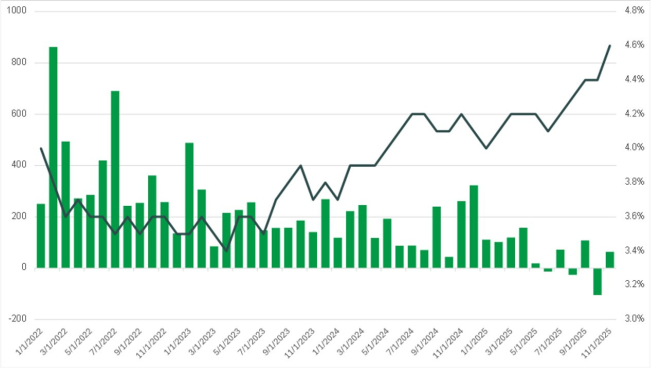 Source: YCharts, Bureau of Labor Statistics
Intuitively the unemployment rate has risen alongside the softening labor market, but perhaps to a lesser extent than many would have expected. The unemployment rate rose from 4.1% in June to 4.6% in November, but the level of both continuing and initial jobless claims were relatively flat on the year (for specifics, from the first to last measure of the year, initial jobless claims declined by 6,000 while continuing claims only increased by 16,000). This dynamic of modest levels of job growth and layoffs has been dubbed the “No Hire, No Fire” job market where employers are hesitant to hire aggressively given macroeconomic uncertainty but simultaneously are not laying off employees at an aggressive rate. While likely very early days, this may be where the impact of artificial intelligence is beginning to be felt as businesses are pressured to increase productivity as these new AI tools hit the market. In addition, the Trump administration’s crackdown on immigration is likely another contributing factor here, as the breakeven level for job creation has come down meaningfully from the prior years when immigration levels were much higher.
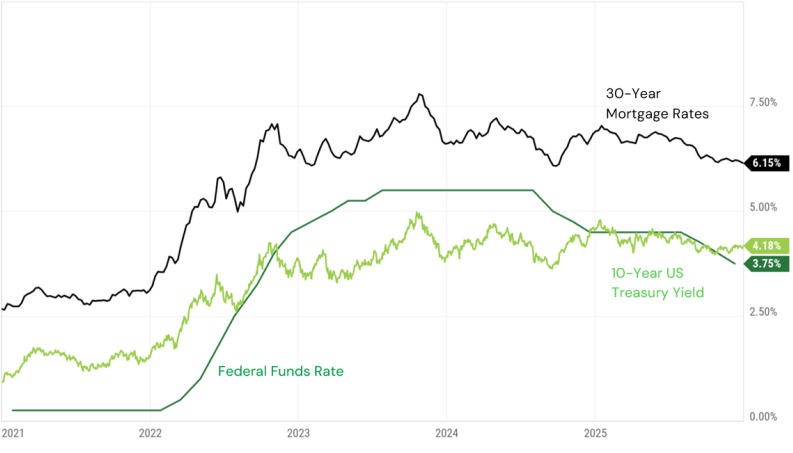
While many would not view the degradation of the labor market as a positive for financial markets, this bad economic news was taken as good news for markets as it provided the catalyst for the Federal Reserve to continue its rate cutting campaign. After cutting interest rates by 100 basis points in 2024, the Fed cut another 75 basis points off the Fed Funds rate to close out 2025. Jay Powell and the Fed cited the softening labor market as the key reason for moving forward with the rate cuts, despite inflation remaining elevated above the central bank’s 2% target.
Mortgage, Fed Funds & 10 Year Treasury Rate
Source: YCharts, Federal Reserve
While markets rallied on the prospect of additional rate cuts in the second half of the year, longer-term interest rates have not moved down to the same degree as the Fed Funds rate. Since the Fed first cut interest rates in September of 2024, the 10-year treasury yield is roughly 50 basis points higher, while mortgage rates are roughly flat. This highlights our belief that longer-term rates (the rates that businesses and consumers generally actually borrow at) are not solely driven by where short-term rates sit. While the CPI did move modestly lower over 2025, the trajectory of long-term rates will be heavily influenced by where inflation moves from here.
Market Update
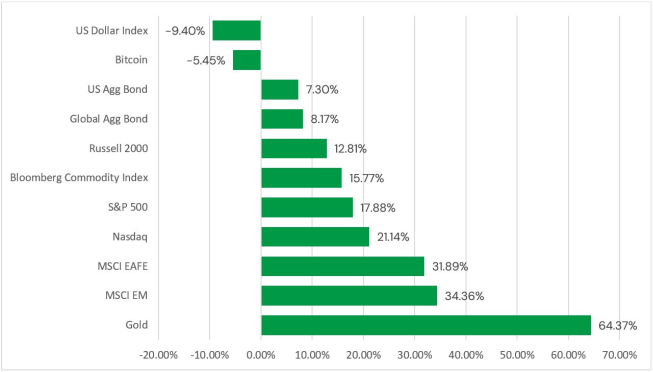
2025 Index Performance
 Source: YCharts, Bloomberg, SQ Investments
Despite the tariff driven selloff in early April, financial markets enjoyed a strong year of performance in 2025. Equities benefited from the robustness of the US economy, earnings growth (particularly from tech-oriented sectors), easing monetary policy, and continued supportive fiscal policy. Scarce assets broadly saw strong performance as the “dollar debasement” trade made headlines, highlighted by Gold’s strongest year of performance since 1979(2). In contrast, after seeing tremendous momentum to start the year, crypto currencies have struggled to keep up with Gold and other financial assets.
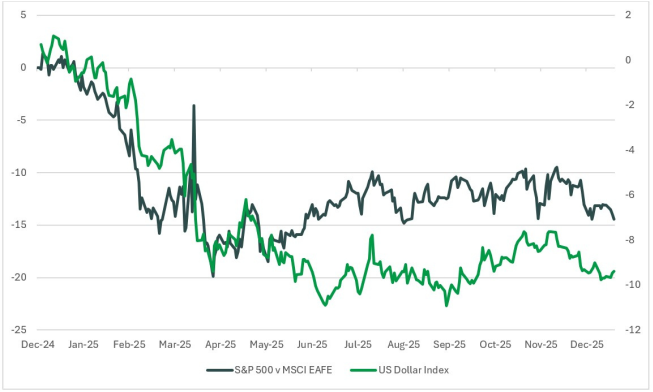
However, one of the biggest stories in financial markets in 2025 was the surprising strength of international markets over the course of the year. After more than a decade of persistent outperformance, the US stock market lagged international peers with the S&P 500 underperforming the MSCI EAFE by 14% over the year. After years of the US being the global driver of growth, international governments leaned more heavily into fiscal stimulus in an attempt to adjust to the new global order of Trump 2.0. For example, Germany significantly increased their budget deficit to address defense and industrial spending needs(3), Japan elected a pro-fiscal stimulus candidate for Prime Minister, and China signaled increases for stimulus programs throughout the year(4). The markets responded favorably to these stimulus programs, with international defense companies being a notable outperformer and beneficiary of this dynamic.
We believe another major driver of the strength in international and emerging markets was due to the weakness of the US Dollar. The US Dollar Index, an index tracking the US dollar across a basket of foreign currencies, detracted just over 9% on the year(5). Fears of “de-dollarization” or the end of the US Dollar as a reserve currency peaked in the first half of the year amidst the tariff turmoil, but the dollar steadied at the index level through the second half. This FX softness coincided with the underperformance of domestic equities – as the below chart highlights, domestic equity underperformance was concentrated in the first half of the year as well, with US markets making up some ground over the course of Q3 and Q4. The fears of aggressive repositioning by global investors away from US assets proved to be either overly cautious or premature, particularly as demand for US tech stocks remained strong.
Relative Performance of S&P 500 vs MSCI EAFE & USD Index
Source: YCharts, SQ Investments
Despite the underperformance against international equities, the artificial intelligence trade continued to shine in 2025 – both in the US and abroad. While the concentration of performance within the Magnificent 7 was the story of 2023 and 2024, the AI trade broadened in 2025 to include a wider list of companies involved in the Artificial Intelligence datacenter buildout. This list of beneficiaries expanded to companies across the AI ecosystem, including businesses providing semiconductors and memory, networking and optics, energy infrastructure and even building materials required for datacenters.
These have been the companies at the receiving end of the dramatic level of capital expenditures from the US based hyperscalers. Alphabet, Amazon, Meta, Microsoft and Oracle are expected to have increased their capex to nearly $400 billion for 2025, with expectations for that to continue to rise in the coming years. This doesn’t include large spending commitments from private AI players as well, such as OpenAI, Anthropic, and xAI. However, while the market cheered on commitments from these companies to increase capex most of the past few years, the tone changed in late 2025 when investors began to grow more cautious over the level of spend without commensurate revenues.
Despite the AI theme being a core driver of returns on the full year, the fears of overspending in the ecosystem grew into the end of the year, pressuring AI sensitive companies. Markets broadly held up at the index level as investors rotated into non-AI beneficiaries across value and small cap exposure. Regardless of whether revenues start to grow for the AI ecosystem, how investors respond to the continued level of heavy capex from leading tech companies (and if productivity benefits spread to the non-AI companies) will be critical questions heading into 2026.
Hyperscaler Capital Expenditure Growth
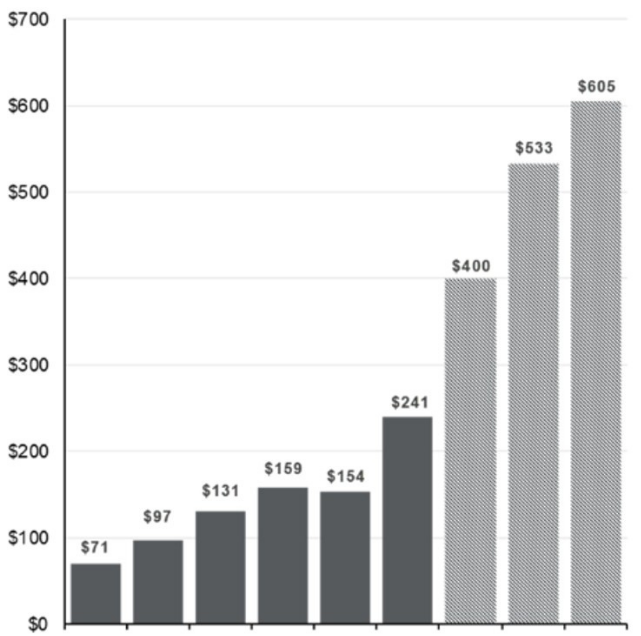
Source: JP Morgan Asset Management, Bloomberg. USD Billions; Alphabet, Amazon, Meta, Microsoft, Oracle
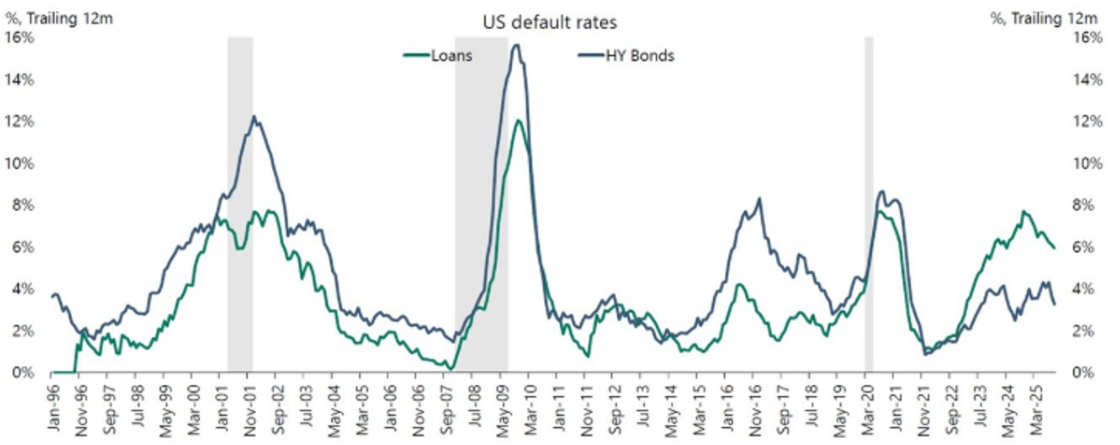
Lastly, credit and income oriented fixed income had another solid year of performance, although a handful of high-profile defaults made headlines in the second half of 2025. After years of highly benign credit markets, we saw a pickup in defaults across both loan and bond markets in 2024 and into 2025. In the early fall, the defaults of auto lender Tricolor and auto supplier First Brands, along with a warning from JP Morgan CEO, Jamie Dimon, caused fears of potential widespread credit issues in the less regulated private credit market. While these defaults, along with a handful of others in the second half of 2025, were painful situations for investors who owned loans to these companies, they have so far proven to be idiosyncratic events that have not resulted in widespread increases in defaults.
As the below chart highlights, default rates in the US have peaked for the time being and have actually been moving lower in recent quarters, despite these high-profile defaults. While returns have moved lower for many private credit investments due to the floating rate nature of their loans (who’s coupon payments move in lockstep with Fed policy), high quality private credit managers with robust diligence have largely avoided these troubled credits. This was a key period, proving out the notion that allocating to experienced investors in the space is critical to maintaining a high degree of return in the asset class.
US Default Rates of Loans and Bonds
Source: Apollo Chief Economists, Moody’s Analytics; As of December 5th 2025
Conclusion
2025 proved to be another strong year for financial markets and investment portfolios, despite numerous headline shocks and unexpected developments. As we enter 2026, risks remain present, as they always are, including elevated valuations across both equities and credit, ongoing geopolitical uncertainty, and an AI-driven investment theme that has propelled markets in recent years.
Against this backdrop, Simon Quick continues to emphasize diversification as an all-weather approach to long-term financial planning. In an environment where the path forward is inherently uncertain, maintaining a well-constructed portfolio across asset classes and risk factors remains the most effective way to manage risk, stay disciplined, and avoid the emotional decision-making that can undermine long-term investment outcomes. By focusing on portfolio construction rather than short-term predictions, investors are better positioned to navigate this uncertainty and remain aligned with their long-term objectives.
- “U.S. International Trade in Goods and Services, September 2025 | U.S. Bureau of Economic Analysis (BEA).” Bea.gov, 2025, www.bea.gov/news/2025/us-international-trade-goods-and-services-september-2025.
- Macrotrends. “Gold Prices – 100 Year Historical Chart.” Macrotrends.net, 2023, www.macrotrends.net/1333/historical-gold-prices-100-year-chart.
- Hansen, Holger. “Germany Approves 2025 Budget, Ushering in New Era of Spending.” Reuters, 18 Sept. 2025, www.reuters.com/world/europe/germany-approves-2025-budget-ushering-new-era-spending-2025-09-18/.
- “New Policy Supports Unveiled to Encourage Consumption.” Www.gov.cn, 2025, english.www.gov.cn/policies/policywatch/202503/18/content_WS67d8adcfc6d0868f4e8f0e9e.html.
- “Https://Www.marketwatch.com/Investing/Index/Dxy.” Www.marketwatch.com, www.marketwatch.com/investing/index/dxy.
Disclaimer
The information, analysis, and opinions expressed herein are for general and educational purposes only. Nothing contained herein is intended to constitute legal, tax, accounting, securities, or investment advice nor an opinion regarding the appropriateness of any investment, nor a solicitation of any type.
Please remember that past performance may not be indicative of future results. Different types of investments involve varying degrees of risk, and there can be no assurance that the future performance of any specific investment, investment strategy, or product (including the investments and/or investment strategies recommended or undertaken by Simon Quick Advisors LLC), or any non-investment related content, made reference to directly or indirectly in this presentation will be profitable, equal any corresponding indicated historical performance level(s), be suitable for your portfolio or individual situation, or prove successful. Asset Allocation may be used in an effort to manage risk and enhance returns. It does not, however, guarantee a profit or protect against loss. Due to various factors, including changing market conditions and/or applicable laws, the content may no longer be reflective of current opinions or positions. Moreover, you should not assume that any discussion or information contained in this presentation serves as the receipt of, or as a substitute for, personalized investment advice from Simon Quick Advisors LLC. To the extent that a reader has any questions regarding the applicability of any specific issue discussed above to his/her individual situation, he/she is encouraged to consult with the professional advisor of his/her choosing. Investing in alternatives may not be suitable for all investors, and involves a high degree of risk. Many alternative investments are highly illiquid, meaning that you may not be able to sell your investment when you wish. Risk of alternative investments can vary based on the underlying strategies used.
Certain information contained herein may be “forward-looking” in nature. Due to various risks and uncertainties, actual events or results or the actual performance of the Fund may differ materially from those reflected or contemplated in such forward-looking information. As such, undue reliance should not be placed on such information. Forward-looking statements may be identified by the use of terminology including, but not limited to, “may,” “will,” “should,” “expect,” “anticipate,” “target,” “project,” “estimate,” “intend,” “continue” or “believe” or the negatives thereof or other variations thereon or comparable terminology.
Simon Quick Advisors LLC is neither a law firm nor a certified public accounting firm and no portion of the presentation content should be construed as legal or accounting advice. If you are a Simon Quick Advisors LLC client, please remember to contact Simon Quick Advisors LLC, in writing, if there are any changes in your personal/financial situation or investment objectives for the purpose of reviewing/evaluating/revising our previous recommendations and/or services. Simon Quick Advisors, LLC (Simon Quick) is an SEC registered investment adviser with a principal place of business in Morristown, NJ. Simon Quick may only transact business in states in which it is registered, or qualifies for an exemption or exclusion from registration requirements. A copy our written disclosure brochure discussing our advisory services and fees is available upon request. References to Simon Quick Advisors as being “registered” does not imply a certain level of education or expertise.
Historical performance results for investment indices and/or categories have been provided for general comparison purposes only, and generally do not reflect the deduction of transaction and/or custodial charges, the deduction of an investment management fee, nor the impact of taxes, the incurrence of which would have the effect of decreasing historical performance results. It should not be assumed that your account holdings correspond directly to any comparative indices. You cannot invest directly in an index.
Indices included in this report are for purposes of comparing your returns to the returns on a broad-based index of securities most comparable to the types of securities held in your account(s). Although your account(s) invest in securities that are generally similar in type to the related indices, the particular issuers, industry segments, geographic regions, and weighting of investments in your account do not necessarily track the index. The indices assume reinvestment of dividends and do not reflect deduction of any fees or expenses.
Please Note: (1) performance results do not reflect the impact of taxes; (2) It should not be assumed that account holdings will correspond directly to any comparative benchmark index; and, (3) comparative indices may be more or less volatile than your account holdings.
Please note: Indices are frequently updated and the returns on any given day may differ from those presented in this document
Economic, index, and performance information is obtained from various third party sources. While we believe these sources to be reliable Simon Quick Advisors LLC has not independently verified the accuracy of this information and makes no representation regarding the accuracy or completeness of information provided herein.
As of April 1st, 2022, Simon Quick Advisors LLC has changed private capital index providers from Cambridge Associates to Pitchbook Benchmarks.